African Bush Elephant

  The African Bush Elephant is the largest of all living creatures on land. The Elephant is thought to have been named after the Greek word for ivory, meaning that Elephants were named for their uniquely long tusks. With male African Bush Elephants reaching up to 3.6 metres in height and the females being slightly smaller at around 3.1 metres tall. The body of the African Bush Elephants can also grow to between 6.1 and 6.9 meters long. The tusks of an African Bush Elephant can be nearly 2.6 meters in length. 

African Bush Elephants have four molar teeth each weighing about 5.0 kg and measuring about 12 inches long. Although the historical range of it's ancestors ranged right into the Arctic Circle. today the African Bush Elephant is mainly found in central and southern Africa in nomadic herds that wander the plains and grasslands of Africa grazing for food and searching for waterholes.

 African Bush Elephant Behaviour and Lifestyle Not only is the African Bush Elephant an incredibly sociable mammal. but it is also a very active one. African Bush Elephants are nomadic animals meaning that they are constantly on the move in search of food, so moving within these family herds allows them to have greater protection both from predators and from the elements. 

African Bush Elephant Reproduction and Life Cycles
African Bush Elephants tend to live relatively long lives, with the average life span being between 61 and 70 years. Female African Bush Elephants reach sexual maturity after 11 or 12 years. but are thought to be most fertile between the ages of 23 and 43. Male African Bush Elephants however often don't reach sexual maturity until they are nearly 20 years old. After mating and a gestation period of up to 2 years, the female African Bush Elephant gives birth to a single calf. The bulk of the African Bush Elephant's diet is comprised of leaves and branches that are stripped off the trees and bushes using it's trunk.

................................................................................................................................................

:- African Bush Elephant images -:


  ????????????????????????????????????????

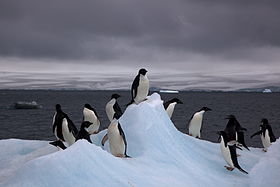
                                Adelie Penguin


Description & Distribution...

              The Adélie penguin is one of three species in the genus Pygoscelis. Adélie penguins is can usually swim  at 9.0 km/h . Mitochondrial and nuclear DNA evidence suggests the genus split from other penguins around 38 million years ago about 2 million years after the ancestors of the genus Aptenodytes. In turn the Adélie penguins split off from the other members of the genus around 19 million years ago.


These penguins are mid-sized being 44 to 70 cm 16 to 26 in height and 3.2 to 6 kg 7.8 to 13.25 bin weight. Distinctive marks are the white ring surrounding the eye and the feathers at the base of the bill. Their appearance is closest to the stereotypical image of penguins as mostly black with a white belly.

Habitat


         Antarctica Based on a 2014 analysis of fresh guano-discolored coastal areas. there are 3.80 million breeding pairs of Adélie penguins in 250 breeding colonies. a 53 percent increase over a census completed 20 years earlier. The Adélie penguins breed from October to February on shores around the Antarctic continent shifts typically last for 10 days.The chicks remain in the nest for 20 days before joining creches.


Diet


     The Adélie penguin is known to feed mainly on Antarctic krill, ice krill, Antarctic silverfish, sea krill and glacial squid diet varies depending on geographic location during the chick-rearing season.
Reproduction


Adélie penguins arrive at their breeding grounds in October or November, at the end of winter and the start of spring. Their nests consist of stones piled together. In December, the warmest month in Antarctica about −2 °C or 28 °F the parents take turns incubating the egg one goes to feed and the other stays to warm the egg. The Adélie penguin lives on sea ice but needs the ice-free land to breed. The parent who is incubating does not eat. In March the adults and their young return to the sea With a reduction in sea ice populations of the Adélie penguin have dropped by 65% over the past 25 years. 


Migration


Adélie penguins living in the Ross Sea region in Antarctica migrate an average of about 13,000 kilometres during the year. as they follow the sun from their breeding colonies to winter foraging grounds and back again. Follow the sun means that during the winter the sun doesn't rise. south of the Antarctic Circle but sea ice grows during the winter months and increases for hundreds of miles from the shoreline and into more northern latitudes all around Antarctica so that as long as the penguins live at the edge of the fast ice there will be sunlight.

Adelie Penguin Images


'"""""""""""""""""""""""""""""

Caiman   

Caimans inhabit in South America.

=> with an average maximum weight of 6 to 40 kg depending on species, which can grow more than 5 m (15.9 ft) in length and weigh up to 1,100 kg.


                                -:-Characteristics-:- 

=>  Males of the species are generally 1.9 to 2 m (5.8 to 6.6 ft).

=>  The body mass of most adults is between 7.1 and 42 kg (14.8 and 89 lb).

=> During colder weather, the black pigment, found within their skin cells, making them appear darker.


 One most famous type of crocodilian.

The Black caiman


-The black caiman is a large crocodilian and along with the American alligator.
-It is a carnivorous reptile that lives along slow-moving rivers, lakes,flooded savannas of the Amazon basin, and in other freshwater habitats of South America.

-They are generalists and apex predators potentially capable of taking any animal within its range, including other predators. it may also be a keystone species playing an important role of maintaining the structure of the ecosystem.
-it was hunted to near extinction primarily for its commercially valuable hide. It is now making a comeback, listed as Conservation Dependent.


-The black caiman is one of the largest extant reptiles. 
-length :- Most black caimans are 2.9 to 4.27 metres.
-The black caiman broadly overlaps in size with the American alligator,although it is on average larger at maturity.
-Several widely reported but unconfirmed sources report that the black caiman can grow to over 6.2 m in length and weigh up to 1,100 kg.

Reproduction:-

 -black caiman lay up to 65 eggs.
-The eggs are quite large averaging 144 g in weight
-The mother will assist chirping unhatched young to break out of the leathery eggs by delicately breaking the eggs between her teeth.
-Baby black caimans are subject to predation even more regularly after they hatch
 The black caiman only breeds once every 2 to 3 years.

   --: Caiman Lizard :--

=========================

The Caiman Lizard has Colours in Black, Brown, Tan, Yellow, Grey.It has Weight is 1.4kg - 2.7kg.The caiman lizard Life Span is 10 to 30 years.It's Biggest Features are Forked tongue and powerful tail. It is show Range at Tropical jungles of Amazonian South America.The Caiman Lizard can run fast speed 17km/h and its Lifestyle is  Solitary.    

=> Caiman Lizard is powerfully built and is one of the largest lizard species on the American continent.
=> Caiman Lizard body of the caiman lizard is very similar to that of a crocodile.
=> These lizards can reach up to 4 ft 1.2 m long and weigh up to 10 lb 4.6 kg There are horned raised scales along the dorsal of the back.

 
=> This help to provide some protection against predators. This species can be found in the countries of Brazil, Colombia, Ecuador, Peru, and the Guiana's.
=> It lives in swampy habitats and other wooded areas which are flooded.
=> This species was heavily hunted for their leather. The caiman lizard spends most of it time in  near water.
=> Caiman lizards in the wild will take a variety of prey snails, fish, craw fish, clams, invertebrate and other freshwater inhabitants all can make up a caiman lizard's diet.
=> The caiman lizards large size and potentially painful bite are two more reasons that few tackle its husbandry.
=> Little is known of its reproductive habits.A wood mulch substrate works.
=> The caiman lizard is a large and powerfully. it built lizard that is known to grow up to 121 centimetres from it's snout to the tip of it's tail.

 
=> Caiman lizards are large carnivorous predators that only hunt other animals in order to gain their nutrients.


-: Caiman Lizard images :-


>>>>>>>>>>>>>>>>>>>>>>>>>>>>>>>>>>>>>>>>>>>>>>>>>>>>>>>>>>>>>>>>>>>>>>>


                                              Baboon Animal

Baboon is the great animal of East Africa.They are very strong and powerful primates.Baboon animal has span life 20 to 30 years.All in East Africa Monkeys frequent interaction with people. It is intelligent and crafty.it has size: -14 to 30 inches at the shoulder.Physical Characteristic is The 2 most common baboons occur in East Africa, the olive baboon and the yellow baboon.The major requirements for any habitat seems to be water sources and safe places. Baboons are found in surprisingly varied habitats.Baboons are fierce fighters but a demonstration such as this can put the predator on the run.It Monkeys are different. For example almost all species of monkeys are very flat nose. This is despite a very long and large nose.These fossil remains though are larger than the Baboon today so that is something to take a closer look at.When you consider that 25 years ago they had 40% forest region you can see how they have had to adapt to changes in order to survive.He will have time to rest between being with each of them. very gentle with the Baboons including the males bringing them food.

--: Food for baboon :--
 What eat Baboons ? know hear --->  Baboons carefully choose their food. Grass, making a large part of their diet. Berries, seeds, pods, flowers, leaves, roots, bark and sap with a variety of plants. Baboons also eat small quantities of insects, fish and small antelope meat. _________________________________________________________________________________

Baboon Animal Images......


>>>>>>>>>>>>>>>>>>>>>>>>>>>>>>>>>>>>>>>>>>>>>>>>

...............................................................................................


Next PostNewer Posts Previous PostOlder Posts Home